E is for Evaluate
Setting a goal is just the beginning. What keeps it alive — and keeps you moving towards it — is what you do in between.
“Evaluating what you're doing is so important. What worked, what didn't, what can I do better?”
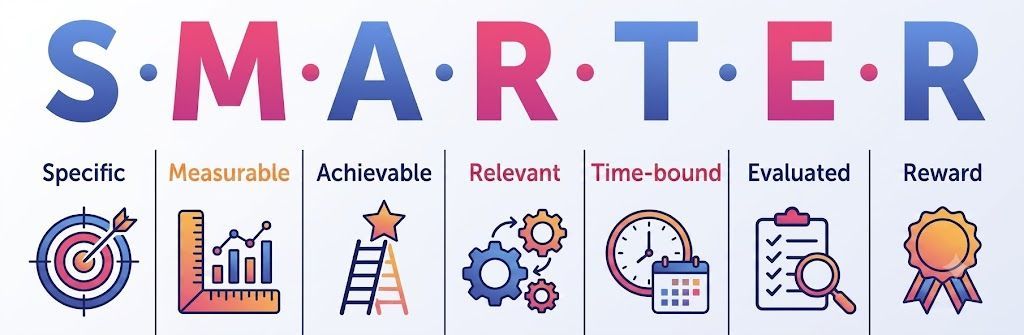
We're six letters into the SMARTER framework now. We've covered Specific, Measurable, Achievable, Relevant and Time-bound. Today we reach E for Evaluate — and I'll be honest with you, I think this might be the most important letter of the lot.
Why Evaluate?
I'm three and a half months into training for my triathlon, which is the first weekend in July. I'm back at the pool this morning for a swim session — wet hair at the end will confirm I actually got in. And swimming is something I spend a lot of time evaluating. How is my stroke? How has it developed? Is it as good as it can be? Can I improve it?
In the last three months I've felt a real difference in my swimming — and that's directly because of the habit of evaluating. Asking the questions. Looking at what the data says. Adjusting.
Without that, I'd just be getting in the pool and splashing around.
Evaluation Keeps You on Track
Whatever your goal — fitness, business, personal — regular evaluation is what stops it from quietly fading away. It's the weekly check-in that asks:
What worked this week? What didn't? What can I do differently?
These aren't difficult questions, but most people never ask them. They set a goal in January and then wonder why nothing has changed by March. Evaluation is the habit that sits between setting the goal and achieving it.
When the Goal Needs to Change
Sometimes evaluation reveals something bigger — that the goal itself needs reframing.
If you set out to run a half marathon in six months and you've never run before, three months in you might find that timeline was a little ambitious. That doesn't mean you abandon the goal. It means you adjust it. Change the timeframe. Recalibrate. The destination stays the same; the route just looks a little different now.
This isn't failure. This is smart goal setting in action.
Evaluation in Business
The same principle applies directly to growing a business. Say you're using several channels to reach new clients — adverts in local magazines, networking groups, social media campaigns. Evaluation asks: which of these is actually working?
What isn't working isn't a failure. It's a learning point. It tells you that for your ideal client, that particular avenue isn't the right one — so you reposition, change direction, and focus your energy where it's actually getting results. Without evaluation, you'd keep spending time and money on things that aren't moving you forward, never knowing why the goal felt out of reach.
Make It a Habit
I wear a Garmin watch when I train. After every session I go home and look at the data — how did I do, where did I improve, what needs work. That information is only useful if you actually capture it.
So whatever your goal, build in the habit of recording. Take notes. Track numbers. Keep a log. Evaluation only works if you have something to evaluate against.
Your Turn
Set aside time this week — even just fifteen minutes — to evaluate where you are with your goal.
- What has worked well since you set it?
- What hasn't worked, and what does that tell you?
- Does the goal itself still make sense, or does something need adjusting?
- What one thing will you do differently next week?
Write the answers down. Then do it again next week. That rhythm is what turns a goal from a good intention into a real result.
The Takeaway
Goals don't achieve themselves between the moment you set them and the moment you reach them. Evaluation is what happens in that space. It keeps you honest, keeps you learning, and keeps you moving. Whatever you're working towards — check in with it regularly, ask the hard questions, and don't be afraid to adjust. That's not giving up. That's how it works.
Next in the series: We reach the final letter — R for Reward. How do you properly close out a goal, learn from the whole journey, and set yourself up for what comes next? Find out in the finale.