S is for Specific
Your New Year’s resolutions haven’t failed, they just need a sharper edge. Here's how one simple shift can change everything.
“We make New Year's resolutions — let's call them goals. But they can be a bit vague. The way to make them happen is to actually define them better.”
It's that time of year when those bold January intentions have quietly faded into the background. "Get fit." "Lose weight." "Grow my business." Sound familiar? You're not alone — and more importantly, you haven't failed. Your resolutions just need a better framework.
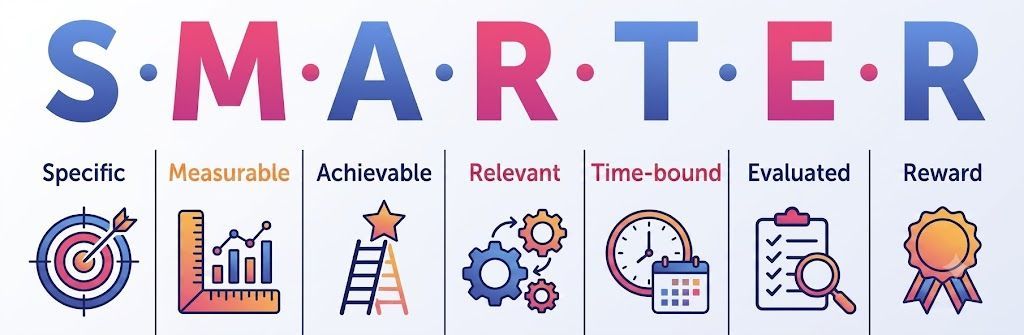
That's where SMARTER goals come in. Over this series, we'll work through each letter and show you how to transform fuzzy wishes into real, achievable outcomes. We start with the foundation: S for Specific.
Leading by Example
I've booked a triathlon this summer. That's my goal — specific, defined, and it's in the diary. I have a clear event to train for and a set period to get ready. There's no vagueness: I know exactly what I'm doing, and when. That single act of specificity changes everything about how I train, plan, and prioritise. That's the power of S.
Notice the difference between "I want to get fit" and "I'm doing a triathlon in July." The second one tells your brain exactly what to do next. It creates focus, urgency, and a clear finish line to aim for.
The Problem With Vague Goals
Most New Year's resolutions fall into the same traps. They feel motivating in the moment but give you no real direction. Without specificity, your brain doesn't know where to start — so it doesn't.
❌
Vague: I want to lose weight.
✓Specific: I want to reach
target weight. That's what I'm aiming for — and now I can work out exactly how to get there.
❌
Vague: I want to grow my business.
✓Specific: I want to engage 10 new clients in the first half of this year. I want to increase my margins by X%.
❌
Vague: I want to get fit.
✓Specific: I will complete a triathlon this summer. It's booked. It's real. And I'm training for it.
Five Questions to Make Any Goal Specific
A truly specific goal should answer as many of these as possible. If it can't, it needs more work.
- What exactly do I want to achieve? Not "lose weight" — what weight? Not "grow my business" — how many clients, by what percentage?
- Who is involved? Is this just you, or does it include a team, a partner, or a coach?
- Where will this happen? A specific context or location helps anchor the habit.
- When will I do the work — and when is the deadline? A triathlon in summer. Ten new clients in the first half of the year.
- Why does this matter to me? Your reason is the fuel that carries you through the hard days.
Your Turn: Rewrite Your Resolution Right Now
- Write down your original resolution exactly as it was in January.
- Ask yourself: is it specific enough that a stranger could read it and know exactly what you're going to do?
- Run it through the five questions above — What, Who, Where, When, Why.
- Rewrite it as one clear, concrete sentence. Read it back. Does it feel real and actionable? Then you've just made it SMARTER.
The Takeaway
When you're thinking about your goals — whether they're leftover New Year's resolutions or ones you're setting right now — make them specific. A specific goal has a direction. It tells you where you're going and what success actually looks like. Everything else in the SMARTER framework builds on this foundation. Get this right first, and the rest becomes much easier.
Next in the series: We look at M — Measurable. How do you actually know when you've hit your goal? If you can't measure it, you can't manage it.