A is for Achievable
Ambition is a wonderful thing. But set the bar too high and it can work against you. Here's how to find the sweet spot.
"Having goals that are achievable doesn't mean downgrading your expectations. It's about providing a goal that you know, if you work hard and do the things you need to do, could be achieved."
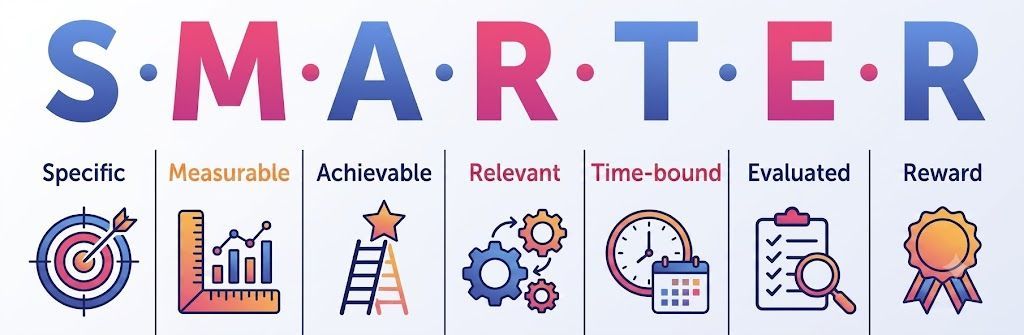
So far in this series we've looked at S for Specific — getting crystal clear on what you want — and M for Measurable, making sure you can track your progress along the way. Now we come to A for Achievable. And if you're anything like me, this one will resonate.
The Overreacher’s Dilemma
I'll be honest with you — overreaching is a habitual lifestyle for me. I've done an Ironman triathlon. I know exactly what that training demands. So if I were to say to myself "I'm going to do another Ironman in six months," I'd know immediately that it's not realistic. The goal I've set instead — a triathlon in July — is ambitious enough to motivate me, but achievable enough that I can actually get there.
This is the balance Achievable asks you to find.
What Happens When the Bar Is Too High
If you've never run before and you set yourself a half marathon in six months, you're setting yourself up for a very hard experience. If you have a handful of clients and you tell yourself you'll have ten more by Christmas, that's an enormous leap.
When we set goals that are beyond what's genuinely possible in the time frame we've given ourselves, one of two things tends to happen. We either feel like we've failed — when actually we just set the wrong target — or we get discouraged and walk away from the goal entirely. Neither of those outcomes serves you.
Achievable Doesn't Mean Easy
Here's the important thing: achievable doesn't mean small. It doesn't mean safe. It means realistic given where you are right now, what you have to work with, and the time you've set yourself.
If you've never run before but you have a dream of completing a marathon one day, start with a 5K. Six months to go from non-runner to 5K finisher — that's achievable. And when you cross that finish line, something shifts. Nothing breeds success like success. That first achievement spurs you on to the next one, and the next one, and before long the marathon doesn't feel so impossible.
The same logic applies in business. If you have a handful of clients and your vision is twenty, don't make twenty your six-month goal. Ask yourself honestly: what could I achieve in six months if I worked hard and did the right things? Maybe that's two new clients. Maybe it's three. Start there. Win there. Then set the next goal.
When You Do Overreach
Sometimes, despite our best intentions, we bite off more than we can chew. That's okay. The beauty of goal setting is that goals are not fixed — they can be adapted.
You haven't failed a goal. You've learned something about it. Maybe the ambition was right but the timeline wasn't. Maybe the goal itself needs reshaping. Either way, you adjust and keep going. The goal stays alive; it just looks a little different now.
Your Turn
Look at the goal you've been working on through this series. Ask yourself honestly:
- Given where I am right now, is this genuinely achievable in the time I've set?
- If I'm overreaching, what would a more realistic version of this goal look like?
- Is there a smaller stepping stone I could aim for first — something that builds momentum towards the bigger vision?
Write it down. Adjust if you need to. There's no shame in it — there's only wisdom.
The Takeaway
Specific gives you direction. Measurable keeps you on track. Achievable makes sure you're aiming at something you can actually hit. Together, these three are already transforming how you think about your goals. Set the bar at the right height — high enough to stretch you, realistic enough to reach — and you give yourself the best possible chance of getting there.
Next in the series: We look at R — Relevant. Is your goal actually right for you, right now? Choosing the wrong goal can be just as damaging as setting it badly. We'll show you how to make sure yours fits.